Why Is Process Street the Best for Continuous Compliance Workflows?
Compliance teams run dozens of recurring checks each quarter and still miss steps when processes live in scattered spreadsheets and email threads. The result is audit evidence that arrives too late to be useful and repeated rework during reviews.
By the end of this article you will know exactly how Process Street structures task sequences, stores policy versions, and generates proof packs automatically. You will be able to decide whether its three core products meet the documentation, automation, and audit requirements your organization faces next quarter.
What Is Process Street?
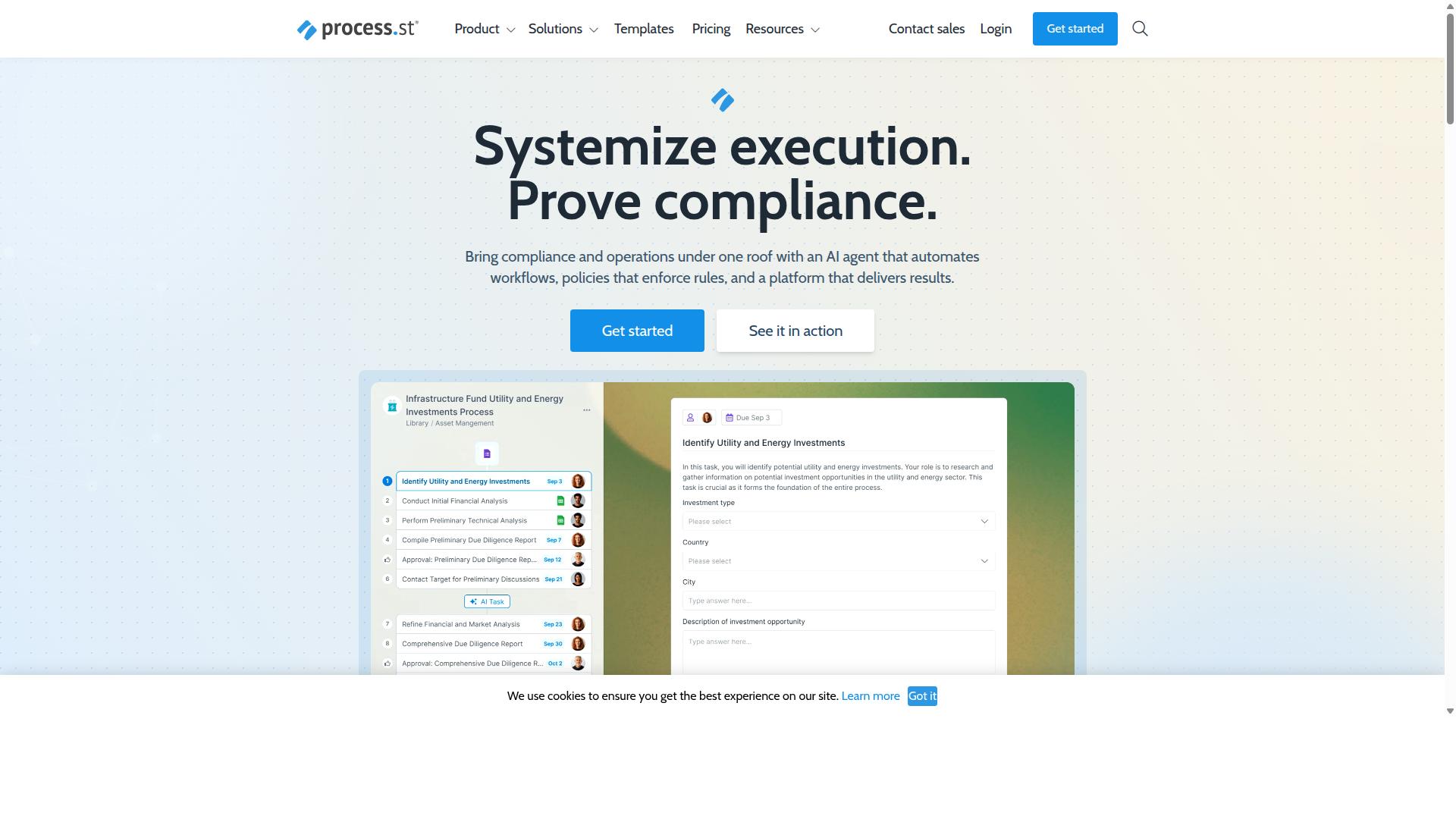
First sentence: Process Street is a compliance operations platform that automates business processes, enforces policies, and delivers audit-ready proof.
The platform combines document management with workflow automation to create unified compliance systems. Organizations use this integration to maintain consistent operational standards across multiple departments.
Process Street offers three main products. Docs handles document management and policy control. Ops manages workflow automation and process orchestration. Cora serves as an AI compliance and risk agent.
This structure helps organizations standardize processes, prove compliance, and maintain operational consistency across industries.
Why Process Street Excels at Continuous Compliance Workflows
Process Street transforms static compliance requirements into living, automated workflows that run daily across regulated operations. Workflow automation replaces manual compliance tasks with consistent, repeatable processes that reduce human error.
Real-time reporting and role-based access give teams visibility into compliance status while maintaining proper security controls. Evidence collection happens automatically as tasks complete, creating a complete record of activities.
Audit trails track every action within the system, showing who performed tasks and when. Deviation tracking flags non-conformances immediately, allowing teams to address issues before they become violations.
IMCD UK reported 30% faster documentation and 75% reduction in setup time after implementing these automated processes. These measurable outcomes demonstrate how continuous compliance becomes manageable through systematic workflow management.
Key Features and What Makes Process Street Stand Out
Three integrated products deliver document control, workflow automation, and AI-driven compliance monitoring.
Each module addresses distinct compliance needs. Docs manages documentation governance. Ops handles process execution. Cora AI provides ongoing oversight and risk detection.
This unified approach keeps compliance efforts coordinated across teams and systems.
Docs for Document Management and Policy Control
Docs provides full governance for ISO 9001, SOC 2, SOX, FDA, and other regulatory frameworks through structured document control.
Version control ensures teams work from current policies. Policy enforcement keeps documents aligned with regulatory requirements. Audit-ready proof supports evidence collection during reviews.
The system maintains data integrity across all stored materials. Teams can track changes and maintain documentation standards without manual oversight.
These capabilities reduce time spent on document retrieval and verification tasks.
Ops for Workflow Automation and Process Orchestration
Ops converts policies into AI-powered workflows that orchestrate tasks across teams with built-in dependencies and approval gates.
Teams assign specific work to individuals while mapping task dependencies. Conditional approval steps ensure proper review occurs before moving forward. Role-based access controls limit who can view or modify sensitive processes.
Real-time reporting shows compliance status across active workflows. The system supports integrations with Zapier, Microsoft Power Automate, Tray.io, Make, and public API access.
Process templates handle standard operating procedures while maintaining consistency across different compliance requirements.
Cora AI Compliance Agent
Cora AI continuously scans workflows for compliance gaps and suggests corrective actions before audits occur.
The agent monitors control effectiveness through ongoing analysis of process data. It generates compliance scorecards that highlight areas needing attention. Regulatory updates get detected automatically as requirements change.
Deviation tracking identifies when processes move outside acceptable parameters. Risk mitigation happens through early detection of potential issues. The system provides automated recommendations based on current workflow patterns.
This continuous monitoring approach supports audit readiness throughout the year rather than just during review periods.
Pricing and Plans
Three subscription tiers accommodate different team sizes and automation needs.
Teams exploring Process Street can start with a free plan that includes five users, ten guests, and limited automation capabilities. This entry point allows small groups to test continuous compliance workflows without upfront investment.
The Startup plan scales those limits further. It supports five users plus ten guests with up to 5,000 Data Set records, ten automation apps, and 100 automation actions monthly. Public API access includes 50 calls each month, giving growing teams enough room for basic regulatory adherence tracking.
Process Street also offers a 14-day Pro trial with no credit card required. During this period, teams access Pro features such as unlimited workflows, custom user counts, and expanded automation options to evaluate fit for their compliance monitoring requirements.
The Pro plan builds on these foundations for established teams. It provides up to 10,000 Data Set records, all automation apps, and custom automation actions. Custom API call limits and guest permissions help organizations maintain audit trails and evidence collection at scale.
Enterprise customers receive the most comprehensive support structure. Custom Data Set records, unlimited Public API access, and a dedicated Success Manager ensure large organizations can manage complex regulatory updates and maintain continuous compliance across multiple departments.
Additional Enterprise benefits include priority support, fully-managed workflows, custom integrations, and bulk document import. Teams also receive process consulting, health audits, and personalized training to standardize SOP management and strengthen policy enforcement.
Each tier preserves unlimited workflows and tasks, ensuring that compliance scorecards, task dependencies, and documentation control can expand alongside business growth without hitting workflow limits.
Trust Signals
SOC 2 Type II and ISO 27001 certifications, plus adoption by 3,000+ companies, demonstrate proven reliability.
These security standards confirm that Process Street meets rigorous requirements for data protection and control effectiveness. Companies handling sensitive compliance data can rely on these credentials when selecting workflow automation tools.
Process Street also holds HIPAA compliance with a BAA available upon request, and meets GDPR, CCPA, and AWS CIS standards. Data never trains AI models, which protects client information during regulatory adherence activities.
Adoption metrics further validate platform stability. More than 1 million users across 3,000+ organizations have standardized processes through the system. This includes 49,000+ employees who completed onboarding workflows without disruption.
Customer satisfaction metrics reflect consistent service quality. A 98% rating paired with a 5-minute average support response time shows that teams receive rapid assistance during compliance monitoring and audit readiness periods.
Who Should Use Process Street
Operations, compliance, HR, finance, and IT teams in financial services, healthcare, manufacturing, and professional services rely on Process Street.
These groups manage continuous compliance through structured workflows. Process Street provides checklist templates that support audit trails and task assignment across departments.
Operations teams use Process Street for quality tracking and process standardization. They maintain consistent procedures while collecting evidence for regulatory adherence.
Compliance departments create ISO compliance workflows with document control and approval workflows. They track deviations and implement corrective actions when needed.
HR teams manage employee onboarding checklists while ensuring policy enforcement and role-based access. They standardize training documentation and maintain audit readiness.
Finance departments utilize approval workflows for expense management and financial controls. They document evidence collection for audit readiness and risk mitigation.
IT and security teams handle access management and security protocols within Process Street. They establish version control for policies and maintain data integrity across systems.
Manufacturing companies apply Process Street to quality assurance workflows and SOP management. They monitor compliance gaps through real-time reporting and task dependencies.
Healthcare organizations use Process Street for patient care protocols and regulatory updates. They track control effectiveness while maintaining documentation control across departments.
Financial services and professional services firms rely on Process Street for client onboarding and capital markets compliance. They implement process mapping and compliance monitoring to meet industry standards.
Final Verdict
Process Street delivers measurable compliance efficiency gains and audit readiness across multiple regulated industries.
Organizations achieve 30% faster documentation and 75% setup time reduction when they implement continuous compliance workflows. These improvements help teams maintain audit trails while reducing manual effort across their operations.
The platform supports task assignment and approval workflows that standardize how companies handle regulatory adherence. Evidence collection becomes more consistent when teams use checklist templates designed for compliance monitoring.
Process Street provides contact options through email and chat support with a 5 minute average response time. Users can also access the platform through AWS Marketplace or submit sales inquiries directly.
Support achieves a 98% customer rating across these channels. This level of responsiveness helps teams address compliance gaps quickly and maintain process standardization throughout their operations.
Recommended Resources: